
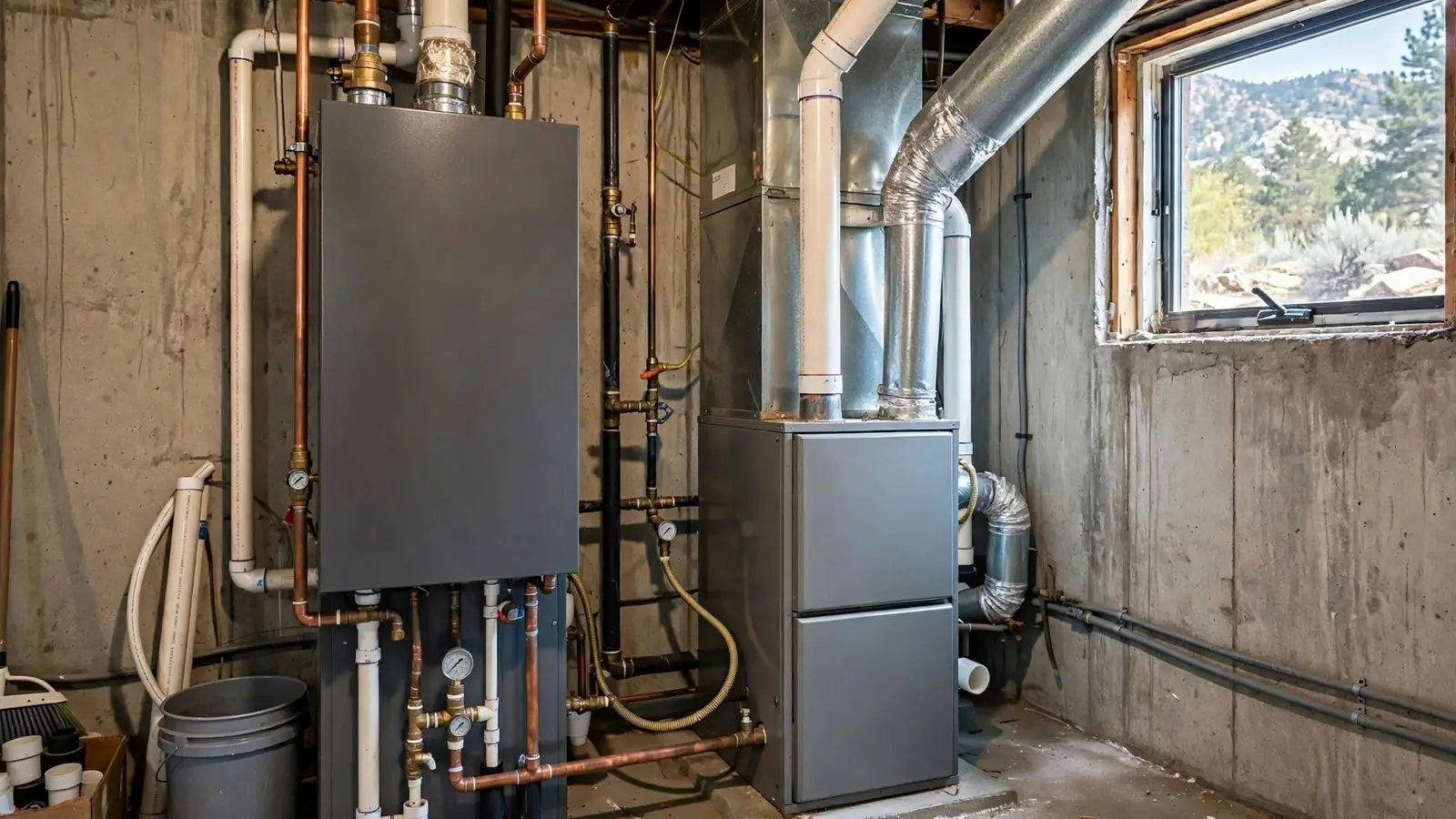
A boiler heats water for radiators or baseboard, and a tankless water heater heats domestic hot water on demand. Homeowners with a boiler often ask whether to keep using it for hot water, add a separate tankless unit, or replace both with a combination boiler.
The answer depends on your fuel, your boiler's age and the way your house is plumbed. This guide lays out the three common setups, with the trade-offs each one carries, so you can have a sharper conversation with a plumber.
Three ways to get hot water in a boiler house
Boiler plus indirect tank
The boiler heats a separate insulated tank through a coil.
- Reuses the boiler you already have
- Supplies large amounts of hot water
- Keeps a stored volume that stays warm
- Uses space for the tank
Boiler plus separate tankless unit
A wall-hung unit makes hot water on demand, and the boiler only heats the house.
- Lets the boiler rest in summer
- Needs its own gas line and vent
- Hard water scale needs flushing
- Adds a second appliance to maintain
Combination boiler
One condensing unit does both heating and hot water.
- Saves space with one appliance
- Needs a good gas supply
- Flow rate is limited at peak demand
- Replaces the old boiler, so it is a bigger job
Why many homeowners keep the boiler for hot water
An old boiler with a coil inside may already make domestic hot water. It works, but running the boiler all summer just for showers wastes fuel. That is the usual reason people look at adding a tankless unit.
If the boiler is in good shape, an indirect tank can be a smoother upgrade than a full replacement. If the boiler is worn out, replacing both with a combi may make more sense. A plumber can test the boiler before you decide.
Questions that decide which setup suits you
| Question | If yes | If no |
|---|---|---|
| Is the boiler under about fifteen years old and running well? | Keep it, add an indirect tank or a tankless unit | Compare replacement options |
| Does your gas line have capacity for a second large appliance? | A separate tankless unit is possible | Choose an indirect tank or combi |
| Do several showers run at once? | Prefer an indirect tank or large tankless unit | A combi or small tankless can work |
| Is there a clear route for a second sealed vent? | Separate tankless is practical | Share one appliance |
If your boiler smells of gas or you see soot
A gas smell, a yellow flame, soot around the boiler or a carbon monoxide alarm is an emergency.
- 1Get everyone, including pets, outside right away.
- 2Call your gas utility or 911 from outside.
- 3Do not relight the pilot or reset the boiler.
- 4Have a licensed plumber or heating technician inspect before use.
Housing mix and shared systems in Voorhees
According to the Census American Community Survey, Voorhees has 12,772 housing units, and 6,522 of them are detached single-family houses. A large share of the rest are in multi-unit buildings, from townhouse-style attached units to apartment complexes with ten or more units.
That mix matters. A detached house can pick its own system, while an apartment or condo building often shares a boiler or a central hot water plant. If you live in a shared building, ask your property manager before planning any change.
Source type: Census American Community SurveyHard water and the heat exchanger
New Jersey American Water's report lists Voorhees hardness at 88 mg/L. Hard water scales any heat exchanger, so a separate tankless unit and a combi boiler both need a flush plan. An indirect tank is less sensitive, though sediment still builds in the tank.
Ask about isolation valves, a scale filter or a softener at the quote stage, not after the unit is on the wall.
A trade-off that gets glossed over
A separate tankless unit saves summer fuel, but it adds a second gas appliance, a second vent and a second service call each year. If your hot water use is modest, an indirect tank on a healthy boiler is often the simpler and cheaper-to-own choice.
What to gather before you ask for quotes
- ✓Boiler make, model and age from the nameplate
- ✓Fuel type and meter size
- ✓Number of bathrooms and typical simultaneous use
- ✓Photos of the boiler room, vent and gas line
- ✓Any history of leaks, banging or low pressure
- ✓Whether the house shares a system with neighbors
How we help with each path
For a failing boiler, boiler repair often comes first, since many problems are a pump, valve or pressure fix. For new hot water equipment, see tankless water heater and water heater installation, and we can talk through the combi option too.
Permit rules vary, so ask the Voorhees Construction Department about the work, and use licensed persons for gas and plumbing.
Beyond Voorhees
We also serve Somerdale and Lindenwold, where mixed housing leads to the same choices. To talk through your boiler, call (855) 575-2890.
Sources and references
The points above draw on these public standards, codes and guidelines. Rules change, so confirm current requirements with the agency or utility named before you rely on them.
- New Jersey American Water: published water quality report (Delaware system) and Camden County service territory information
- NJ Division of Consumer Affairs: State Board of Examiners of Master Plumbers FAQ (N.J.S.A. 45:14C-1)
- U.S. Census Bureau: QuickFacts and American Community Survey 2020 to 2024 estimates