
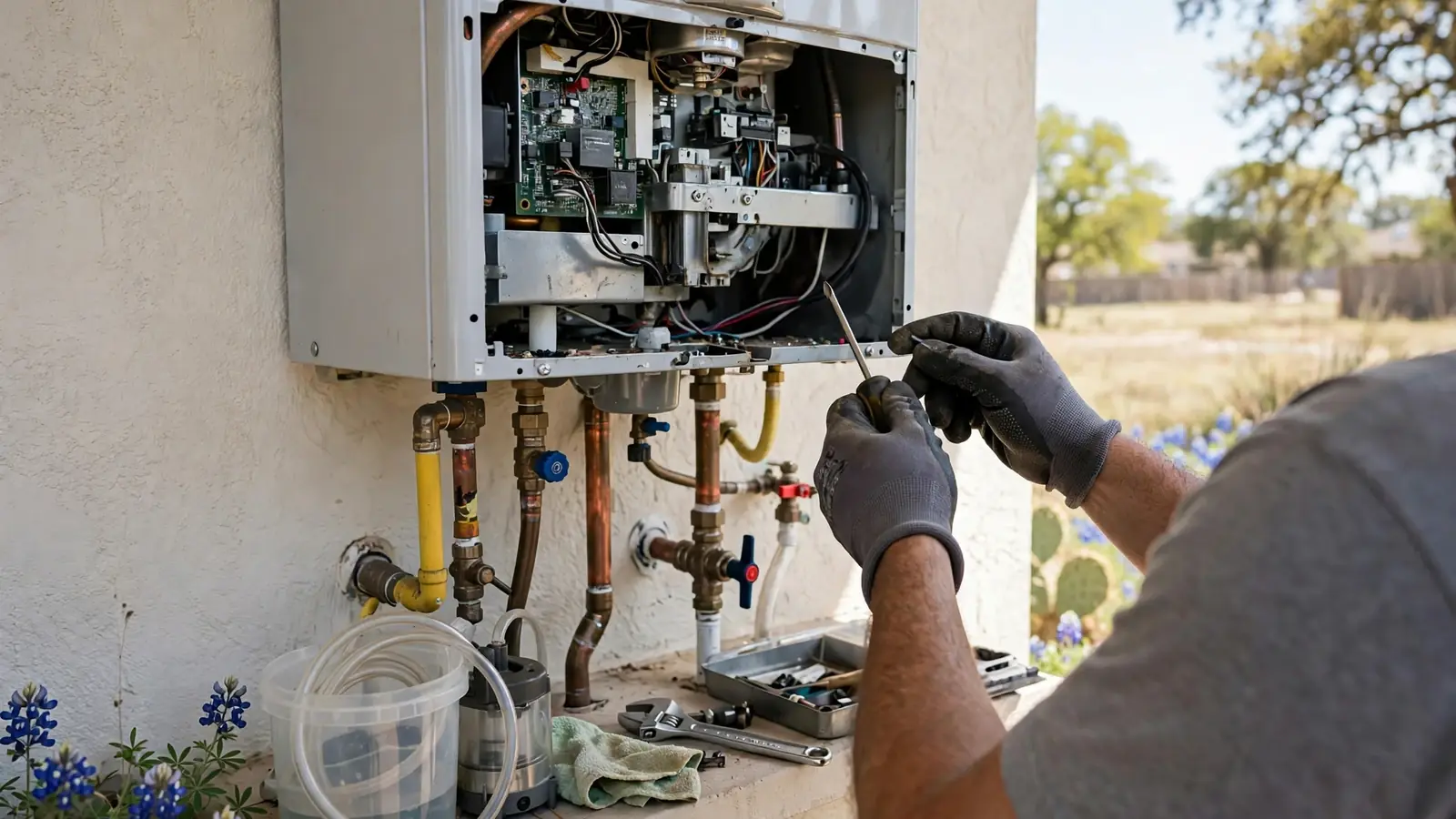
Is tankless right for your house?
It is a good fit for some households and a poor one for others.
Choose tankless if
You want endless hot water and the space back.
- Large family with back-to-back showers
- Wall space but no room for a tank
- A gas line that can be upsized
Think twice if
The house has special limits.
- Gas meter or line is already at capacity
- Water is hard and you will not flush it
- You need hot water during a power outage
A tank is the simpler choice for small, steady households. Our water heater installation page compares the types side by side.
Hard water and tankless: what 88 mg/L means
According to New Jersey American Water's water quality report, the Delaware system that serves Voorhees shows hardness of 88 mg/L, about 5.1 grains per gallon. Heated water drops calcium and magnesium onto the narrow passages of a heat exchanger.
A tankless unit has far less water volume than a tank, so even a thin layer of scale cuts flow and triggers error codes. This is why a yearly flush is part of owning one here, not an optional extra.
Source type: New Jersey American Water water quality reportWhat to do before we arrive
- ✓Smell gas? Leave first. Get everyone out of the building and call your gas utility or 911 before calling a plumber.
- ✓Write down the error code. Most units show a numbered code on the display, and the code narrows the fault quickly.
- ✓Shut the unit off. Turn off its power switch or breaker. If it is leaking, close the cold water inlet valve under or beside the unit.
- ✓Do not open the gas side. Leave the gas valve and burner compartment to a licensed plumber.
How a tankless flush works
A proper descale needs a pump and a bucket, not a garden hose.
- 01
Shut off gas, power and water
The unit is isolated using its service valves. These valves are often missing on older installs, which we add.
- 02
Connect hoses and a small pump
Hoses attach to the hot and cold service ports and a pump circulates a descaling solution through a bucket.
- 03
Circulate for the recommended time
Scale dissolves and the fluid turns cloudy. Time depends on the model and how scaled it is.
- 04
Rinse and clean the inlet filter
Fresh water flushes out the solution. The small screen on the cold inlet is cleaned or replaced.
- 05
Test flow and error codes
We run hot water at several taps, check temperature rise and confirm the unit fires cleanly.
If you have never had yours serviced, the first flush often pulls out more scale than later ones.
Common tankless symptoms and what they mean
| Symptom | Likely cause | Next step |
|---|---|---|
| Water turns lukewarm while running | Scaled heat exchanger or a clogged inlet screen | Flush and descale |
| Cold water sandwich between hot bursts | Flow too low to fire the burner, or a mixing issue | Check flow rate, flush, then inspect |
| Error code on the display | Ignition, venting, flow or sensor fault | Note the code and call |
| Burner clicks but does not light | Gas supply or igniter problem | Check gas valve is open, then call |
| Water leaking beneath | Failed seal, loose fitting or cracked heat exchanger | Shut off water and call now |
| Smells like gas or exhaust | Leak or blocked vent | Leave the building and call the gas utility or 911 |
Gas sizing is the step most quotes skip
A tank burner is small and runs for a long time. A tankless burner is large and runs in short, hard bursts. Many houses built with a tank in mind have a gas line sized for that smaller appliance.
Before an install, the pipe diameter and length from the meter, plus every other gas appliance on the line, have to be checked. The gas utility may need to upsize the meter. Skipping this step is the usual reason a new unit cuts out when the dryer starts.
Venting is the other half. Tankless units need approved stainless or plastic vent pipe, and the distance to windows and air intakes matters.
Service urgency scale
How soon should you act?
Book a yearly flush
No problems yet. Descaling now keeps the unit efficient.
Call this week
Temperature swings, slower hot water or a recurring error code.
Call now
Leak from the unit, no hot water at all, or a burning smell. Use the 24/7 line.
When NOT to go tankless
Skip it if the gas line cannot be upsized at a reasonable cost, or if you are unlikely to keep up with flushing. A neglected tankless unit in hard water can fail earlier than a tank.
What affects tankless costs
Unit size and brand
Higher flow models cost more and need more gas.
Gas line and meter upgrade
Larger piping or a utility meter change adds to the total.
Venting method
Direct vent and wall penetrations take more labor than a simple replacement.
Service valves and filters
Isolation valves for flushing are worth adding at install.
Flush complexity
A heavily scaled heat exchanger takes more time than a lightly scaled one.
Insurance note. Maintenance is not usually covered by homeowner insurance, though sudden water damage from a failed unit may be, so check your policy. Ask for a clear price before work starts and what the manufacturer's warranty requires for yearly service.
Replacing a tank with a tankless unit
If you are moving from a tank, the old unit and any old boiler can be removed and hauled away. Plumbing work must be done by licensed persons in New Jersey, and the Voorhees Construction Department is the office to ask about permits for a change of heater type.
For a failed tank you need hot water back the same day, see water heater replacement. We also serve Somerdale and the nearby boroughs.
Sources and references
The points above draw on these public standards, codes and guidelines. Rules change, so confirm current requirements with the agency or utility named before you rely on them.
- New Jersey American Water: published water quality report (Delaware system) and Camden County service territory information
- NJ Division of Consumer Affairs: State Board of Examiners of Master Plumbers FAQ (N.J.S.A. 45:14C-1)
Common questions
Once a year is the common rule, and water with about 5.1 grains per gallon of hardness is a good reason not to skip it. A water softener can stretch the interval.
It is possible if the unit has service valves, a pump and the right solution. Many homeowners find the gas and power isolation and the hose setup awkward, so a plumber visit is easier.
Scale on the heat exchanger or a clogged inlet screen is the usual culprit. Low flow at the fixture or a gas supply problem can also be behind it.
Most units need electricity for the fan, igniter and controls, so they stop during an outage. A battery backup or generator is the workaround.
Sometimes. You gain space and unlimited hot water, but the savings are modest and the install cost is higher. Gas line capacity may decide it.
We handle the plumbing side, condensate lines and connections. Mention the brand when you call so we can plan the right parts.