
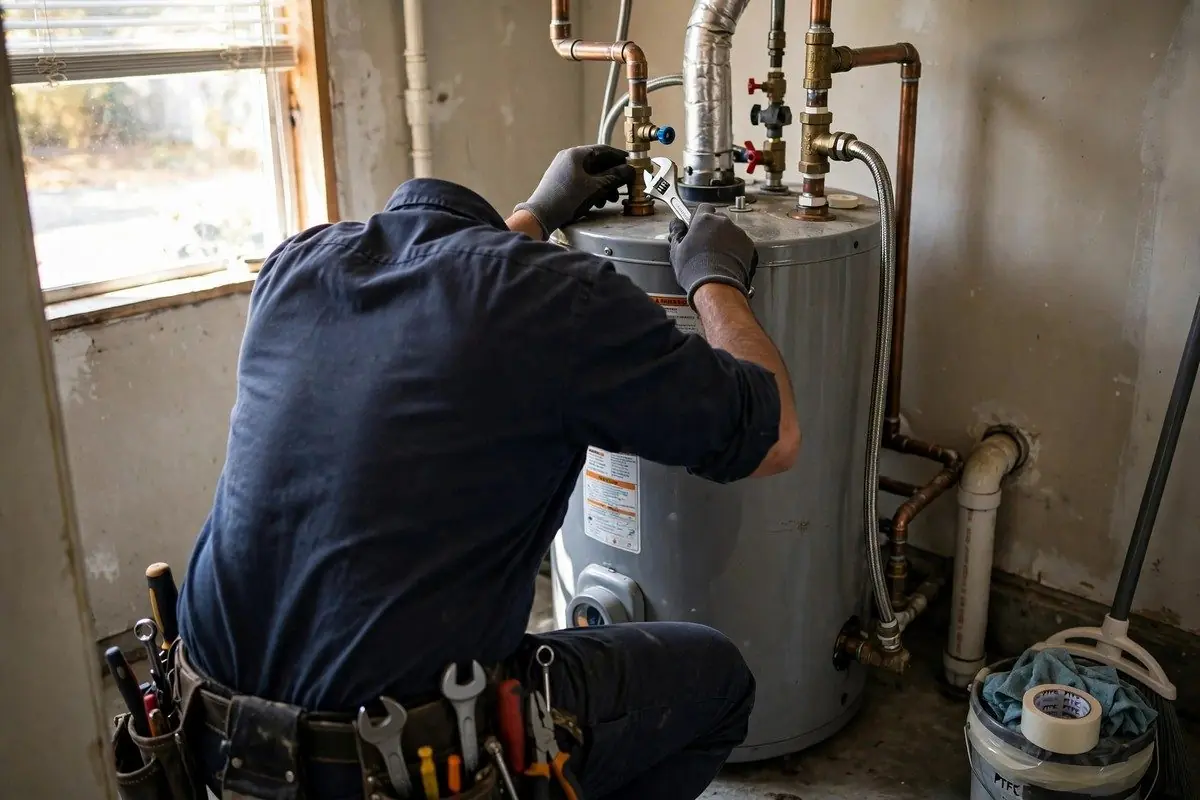
Water heater leaking right now: what to do first
A leak from the tank body is different from a drip at a pipe fitting, and the first few minutes decide how much floor, drywall and storage gets wet. A heater in a garage, basement or utility closet is the usual spot in Voorhees homes, so water often runs toward a floor drain or under a wall.
Call the 24/7 line at (855) 575-2890 once the water is slowed, and ask for a same-day or after-hours visit.
- 1Close the cold supplyTurn the shutoff valve on the pipe entering the top of the tank clockwise until it stops. If it will not turn, close the main water valve for the house.
- 2Kill the fuel or powerFor a gas heater, set the gas control to off or pilot. For electric, switch off the dedicated breaker before you step into any standing water.
- 3Smell for gasIf you smell gas at any point, leave the building and call the gas utility or 911 first. Do not flip switches or light anything.
- 4Move belongings and photograph the damageLift boxes off the floor and take photos of the heater, the data label and the water. Your insurance adjuster may ask for them.
A hot, steaming discharge pipe near the top of the tank is a separate warning. Keep everyone back and do not touch the relief valve.
Symptoms, likely causes and who should fix it
Use this to sort a no-hot-water call from a true emergency. The last column is blunt on purpose.
| What you see | Likely cause | Fix at home or call |
|---|---|---|
| Water pooling at the base | Corroded tank or failed drain valve | Call now. A tank wall leak cannot be patched |
| Drip at the top pipes | Loose supply or hot outlet fitting | Call this week, or now if it is steady |
| Cold water only, gas unit | Pilot out, dirty thermocouple or failed gas control | Relight once by the label. If it fails again, call |
| Cold water only, electric unit | Tripped breaker, failed heating element or thermostat | Reset the breaker once, then call |
| Rumbling or popping | Sediment baked onto the bottom of the tank | Flush may help. Call if the tank is old |
| Rusty hot water only | Anode rod spent and tank lining failing | Call this week and plan for replacement |
A single reset or relight is fine. Repeated trips mean something is failing underneath.
If the leak is a drip at a fitting or the heater is simply cold, you probably have time to call during business hours. Tank-body leaks are the ones that cannot wait.
Why sediment shows up early in Voorhees tanks
According to New Jersey American Water's water quality report, tap water in the Delaware system that serves Voorhees measures 88 mg/L of hardness, about 5.1 grains per gallon. That is moderately hard water, and heating it drops minerals out onto the bottom of the tank and onto electric elements.
In practice that means a gas tank takes longer to heat and runs noisy, and an electric element can burn out under a crust of scale. Annual draining slows this down. Your own tap test or a softener company's meter will give a number for your street.
Source type: New Jersey American Water water quality reportHow we find the fault before touching a part
We work through the heater in a fixed order so a cheap fix is never missed and an expensive one is never guessed.
- 01
Read the data label
Model, serial number and fuel type show the age and the parts that fit. Many tanks carry a build date inside the serial.
- 02
Test the electrical or gas side
A multimeter checks elements, thermostats and the high-limit switch. For gas, we check the thermocouple, pilot flame and gas control valve.
- 03
Inspect the tank for moisture
A flashlight and a dry paper towel show whether water is coming from a fitting, the relief valve or the tank itself.
- 04
Check the safety valve and venting
We confirm the temperature and pressure relief valve discharges to a safe spot and that a gas flue draws properly.
- 05
Give you the options
You hear what is failing, what repair or replacement is possible and the clear price before work starts.
Repair, flush or replace: the honest trade-offs
Not every wet heater is worth fixing, and not every cold one needs a new tank.
Repair a part
Best when the tank is sound and the fault is a thermocouple, element, thermostat, relief valve or drain valve.
- Fast, often same visit
- Does nothing for an old, rusting tank
- A second failure within months points to replacement
Flush and service
Best for noise, slow recovery and a tank that is otherwise healthy.
- Slows scale at 88 mg/L hardness
- Can stir up loose sediment and reveal a leak
- Pointless on a tank that already weeps
Replace the heater
Best for a leaking tank body, rusty hot water or a heater past its normal service life.
- See water heater replacement for sizing and permit notice
- Costs more up front
- Ends the repair cycle
When NOT to repair
If water is coming out of the tank itself, skip the part swap. A new element on a rusted shell is money spent on a heater that will leak again. Ask about a replacement and book it now.
What decides the price of a water heater repair
We give a clear price before work starts. These are the drivers, so you can compare quotes fairly.
Which part failed
A thermocouple or drain valve is a small job. A gas control valve or a replacement element set is bigger.
Gas, electric or heat pump
Hybrid and gas units carry pricier parts than a basic electric tank.
Access to the heater
A tank in a tight closet or crawlspace takes longer to work around than one on an open garage wall.
Water damage already done
A flood can add drying, drain clearing or a damaged shutoff valve to the visit.
Time of the call
Late night and weekend dispatch is priced differently from a scheduled weekday visit.
Insurance note. Homeowner insurance may cover sudden water damage from a failed heater but usually not the heater itself, so check your policy. Ask for the parts, labor and any trip charge in writing so two quotes can be compared line by line.
Before the plumber arrives
A few minutes of prep saves time at the door.
- ✓Clear a path to the heater and remove stored items within three feet.
- ✓Write down the model and serial number from the label.
- ✓Note when the problem started and whether the pilot or breaker has tripped.
- ✓Keep a bucket or wet vacuum ready, and turn the breaker off if water has reached outlets.
- ✓Tell us if a tankless unit is the one acting up, since it needs different parts. Our tankless water heater page covers descaling.
Sources and references
The points above draw on these public standards, codes and guidelines. Rules change, so confirm current requirements with the agency or utility named before you rely on them.
- New Jersey American Water: published water quality report (Delaware system) and Camden County service territory information
Common questions
Yes. The 24/7 emergency line takes calls overnight and on weekends, and we book same-day visits when a technician is available. Shut off the cold supply and the gas or breaker while you wait.
A lit pilot with cold water often points to a failed gas control valve, a dip tube that has broken, or a tank full of sediment. A technician can test the gas valve and the outlet temperature to tell which.
No. If the tank body leaks, the steel liner has failed. Leaks at pipe fittings, the drain valve or the relief valve can be repaired, which is why the source of the water has to be confirmed first.
Popping is usually steam bubbles forcing through sediment. It is not an explosion risk on its own, but it shows the tank is working too hard, and a flush or replacement should follow.
Yes. Tankless units need the heat exchanger flushed with descaling fluid, especially with water that has about 5.1 grains per gallon of hardness. Mention the brand and error code when you call.
It can. Scale insulates the tank bottom and coats elements, so units run hotter and wear faster. Flushing the tank on the manufacturer's schedule and having the anode rod checked from time to time are the cheapest defenses.