
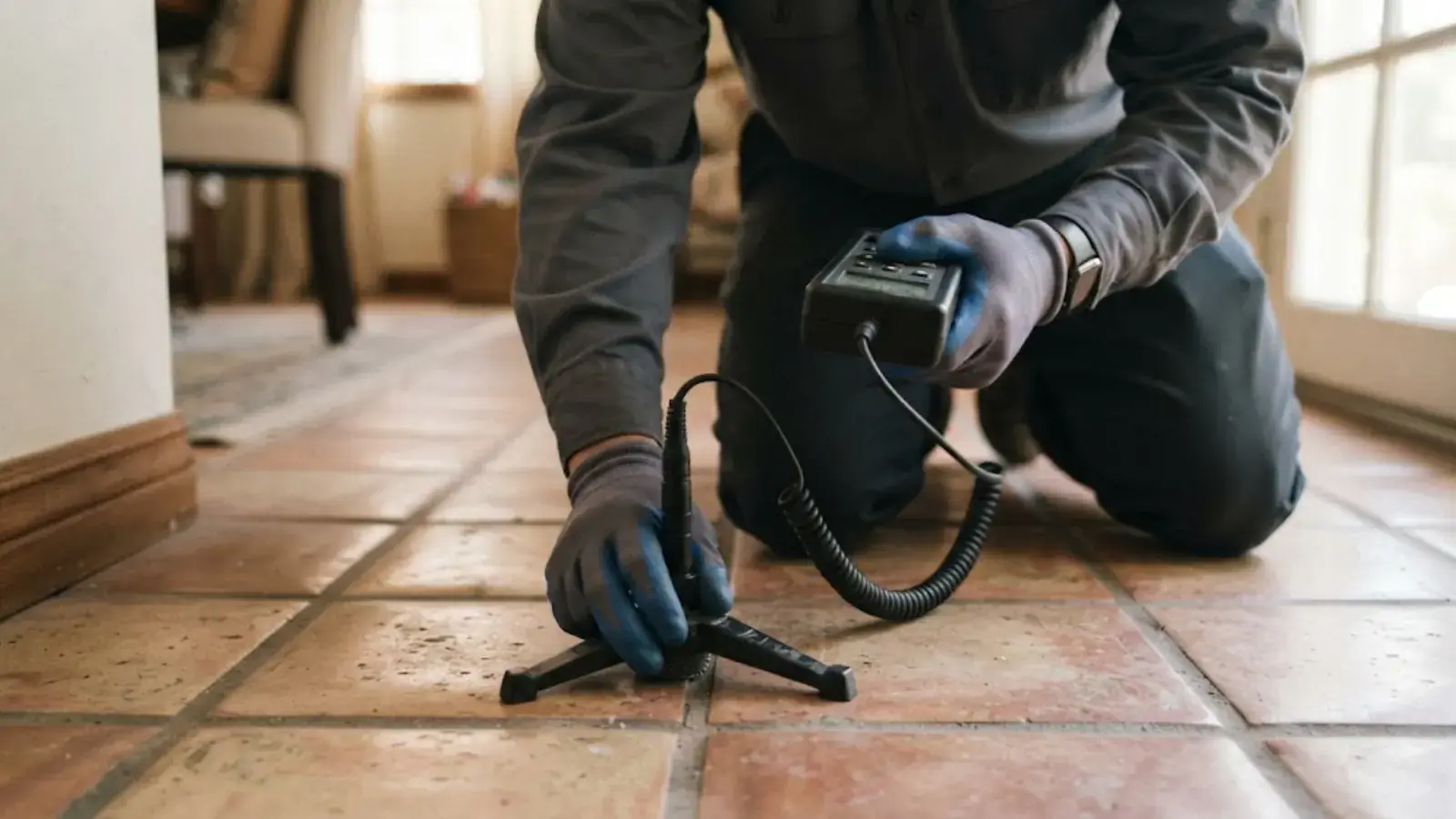
Where leaks hide and how we find them
Moisture meter and thermal camera trace the wet path
Acoustic listening and pressure test pinpoint the pipe
Ground microphone and meter test between house and street
Visual check of fittings, relief valve and tank seams
Zone-by-zone pressure test
The meter test: is water leaking right now
This takes ten minutes and tells you whether the leak is real.
- ✓Turn off everythingClose every faucet, stop the dishwasher and washer, and make sure nobody flushes.
- ✓Read the meterFind the low-flow dial or the small triangle that spins with even a drip, and note its position.
- ✓Wait fifteen minutesDo not use any water. Check the dial again.
- ✓CompareIf it moved, water is leaving your system. If it did not, the leak may be intermittent or the high bill comes from usage.
- ✓Close the main valve and check once moreIf the meter still moves, the leak is between the meter and your shutoff, which is the service line.
A running toilet is the most common cause of a moving meter, so check the flapper before you assume the worst.
Your water meter, your bill and your service line
New Jersey American Water supplies Voorhees, and its meter is the best leak detector you own. A jump in the usage on your bill with no change in habits is a reason to run the meter test above and then call.
New Jersey law adopted in 2021 requires lead and galvanized service lines to be replaced by 2031, and the utility says it will replace customer-owned lines it finds to be lead or galvanized. If we find a failing service line, we will tell you what it is made of so you can ask the utility before you pay for a repair.
Source type: New Jersey American Water press release and New Jersey service line replacement lawWhich detection method fits which leak
| Suspect location | Method | What it shows |
|---|---|---|
| Wall or ceiling stain | Moisture meter, thermal camera | Wet area and source direction |
| Warm spot on a floor | Thermal imaging, then listening | Hot line leaking in or under a slab |
| Wet yard between house and street | Ground microphone, meter test | Service line break |
| Crawlspace damp or musty smell | Visual and moisture check | Drip at a joint or valve |
| Pressure drop with no visible water | Pressure test by section | Which branch is losing water |
| Sprinkler zone with a soggy patch | Zone isolation | Broken head or buried pipe |
Active leak right now: first steps
An actively dripping ceiling or a water heater leaking in the garage is an emergency, and the 24/7 line is the fastest way to a plumber. The first ten minutes decide how much damage you get.
- 1Shut off the waterClose the main valve, or the cold supply to the water heater if that is the source.
- 2Cut power near waterTurn off breakers for wet rooms. Never touch a wet outlet.
- 3Catch and containPut buckets under drips and move belongings out of the path.
- 4Photograph the damageYou will want pictures if you file a claim.
- 5Call usWe offer same-day scheduling when available and can talk you through the shutoff.
If you smell gas, leave the building first and call the gas utility or 911 from outside. Do not look for the source yourself.
Non-invasive detection versus opening the wall
Detection first
Locate, then open one small hole.
- Repairs a drywall patch, not a whole room
- Costs a detection fee up front
- Works on slabs and buried lines
Open and search
Remove material until the leak shows.
- Faster for an obvious pipe
- Risks damage to good wall and flooring
- Poor choice for a slab or a yard
The honest limit is that tools narrow a leak to a few feet, not to an inch. Some jobs still need a test hole to confirm.
What drives the price of a leak search
Where the leak is suspected
A visible bathroom ceiling is simpler than a slab or a buried line.
Size of the property
More pipe and more rooms add time.
Equipment needed
Thermal imaging, listening gear and pressure testing are layered as needed.
Access
Crawlspaces, locked rooms and finished walls change the approach.
Repair after detection
Fixing the leak is separate from finding it.
Insurance note. Homeowner insurance may cover the sudden damage a leak causes but not the pipe repair or a long-term seep, so check your policy and keep your photos. When comparing quotes, ask whether the detection fee is credited if you hire the same company for the repair.
What happens once we find it
If the leak is in a supply line that has failed, the fix may be a short splice or a section replacement through burst pipe repair. Piping may be replaced to repair a leak as ordinary maintenance under New Jersey rules, which usually keeps paperwork simple.
A leak in a drain or sewer line is a different job, covered by sewer line repair. If a pipe shows widespread pitting, we will tell you plainly and discuss water line repair or a larger plan.
Homes and businesses we visit
We look for leaks in single-family houses, apartment buildings, offices and shops, including floors with drains that overflow when a fixture leaks upstairs. We also take calls from Gibbsboro and the other towns around Voorhees.
Tell us at booking whether you have a slab, a crawlspace or a basement, and whether a sprinkler system is on the property.
Sources and references
The points above draw on these public standards, codes and guidelines. Rules change, so confirm current requirements with the agency or utility named before you rely on them.
- New Jersey American Water: published water quality report (Delaware system) and Camden County service territory information
- NJ One Call: call-before-you-dig safety guidance
- New Jersey American Water: lead service line replacement information
Common questions
Yes. The 24/7 line takes calls overnight and on weekends, and a plumber can be sent the same day when available. Shut off the water and call if the leak is active.
Warm spots on the floor, the sound of running water with fixtures off, a high bill and a meter that moves are common signs. A detection visit confirms it with listening gear and pressure tests.
It might be. Run the meter test in this page. If the meter moves with all fixtures off, there is a leak. If it does not, check usage and seasonal irrigation.
Yes. A ground microphone and a meter test narrow a buried service line break to a few feet. We recommend calling 811 before any digging.
If the stain is spreading or damp, yes. Closing the main stops the damage while you wait. Keep your water heater off if the tank may run dry.
No. If you smell gas, leave the building and call the gas utility or 911 from outside. We find water leaks only.