
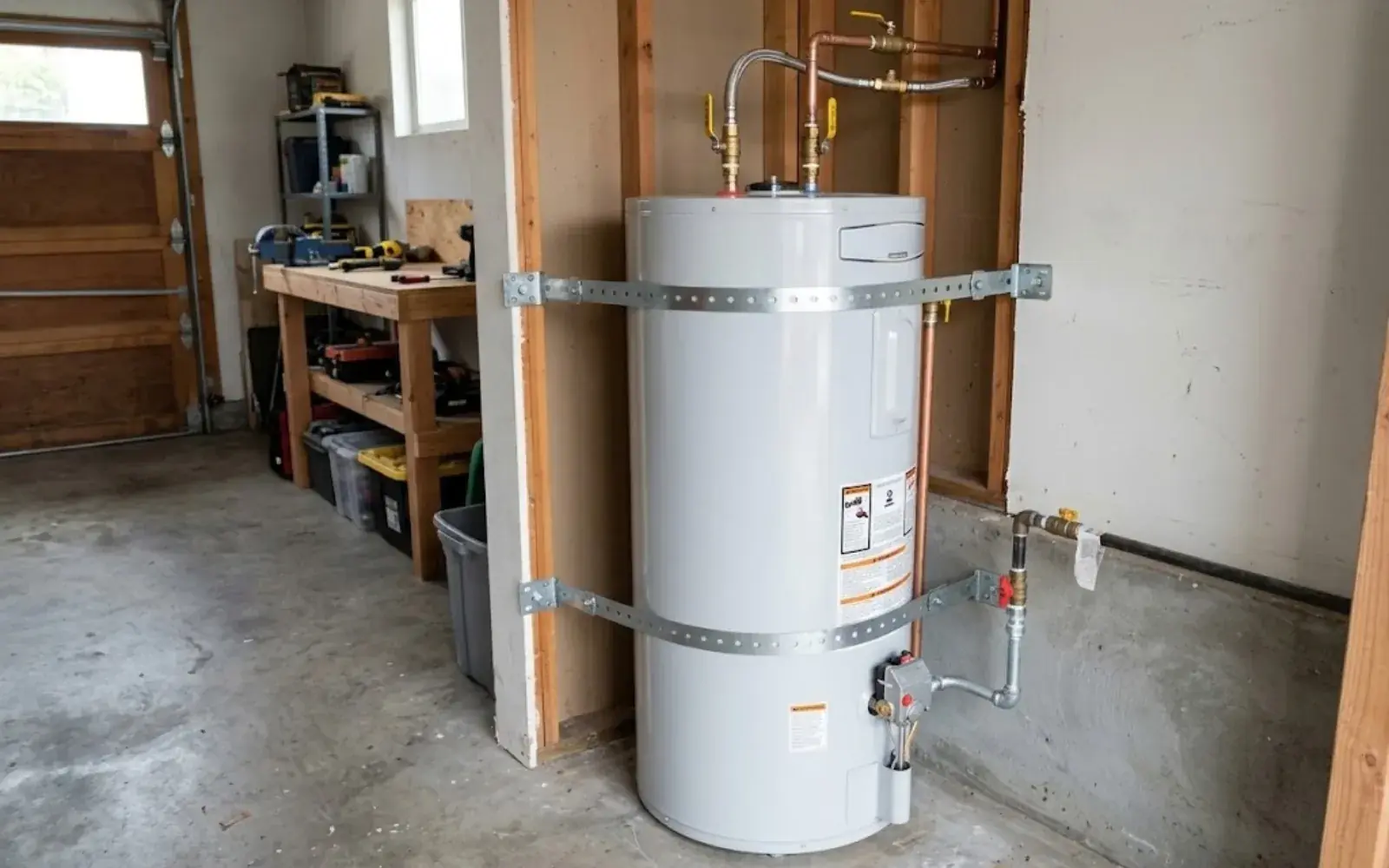
What a planned install covers that a swap does not
A swap reuses what is already there. An install question starts earlier: where will the heater live, what fuel will it burn, how will exhaust leave the building and where will a relief valve discharge.
These choices are cheap to settle on paper and expensive to fix after the drywall is closed. That is why we look at the space, the panel, the gas meter and the floor drain before ordering a unit.
Planning checklist before you book
Work through these and the quote you get will be much closer to the final bill.
- ✓Pick the fuel: natural gas, electric, propane or heat pump, depending on what the house already has.
- ✓Measure the space, including ceiling height, door width and clearance on all sides.
- ✓Count bathrooms, showers and appliances that run at the same time.
- ✓Note where the nearest floor drain, sump pit or exterior wall is.
- ✓Check the electrical panel for a free breaker slot if you want an electric or heat pump unit.
- ✓Ask whether the location is inside a finished room, a garage or a crawlspace.
Venting and fuel by heater type
| Heater type | Venting | What to plan for |
|---|---|---|
| Atmospheric gas tank | Metal flue pipe rising to a chimney or vent | Draft, clearances and a flue that slopes upward |
| Power vent gas tank | Plastic or metal vent out a side wall, with a fan | An outlet for the blower and a clear exit location |
| Direct vent gas tank | Two pipes through the wall for intake and exhaust | Wall penetration and distance from windows |
| Electric tank | No flue | A dedicated breaker, wire size and a drain pan |
| Heat pump hybrid | Exhausts cooler air into the room | A large room, condensate drain and nearby power |
Exact clearances and vent materials come from the manufacturer's manual and the plumbing code. Ask the Voorhees Construction Department when anything is unusual.
Tankless installs have their own gas and venting needs, covered on the tankless water heater page.
From quote to first hot shower
- 01
Site visit
We look at the space, meter, shutoff valves and wiring, and measure for the new unit.
- 02
Choose the unit and the layout
You decide the size and type. We note any new gas piping, vent run or drain line.
- 03
Notice to the township, if needed
Like-for-like swaps are minor work needing notice to the enforcing agency. Other layouts may need more, so we ask first.
- 04
Install day
Old equipment comes out, the new heater is set on a drain pan or level base, and all connections are made.
- 05
Pressure, gas and flue testing
We check for leaks, flue draft and relief valve discharge before running the heater.
Permits and code in Voorhees
New Jersey's plumbing subcode follows the 2021 National Standard Plumbing Code, and the Voorhees Construction Department at 2400 Voorhees Town Center handles building, plumbing and electrical permits. Plumbing work must be done by licensed persons under state law.
For a straight like-for-like replacement, the state treats it as minor work with notice to the enforcing agency. A new location or a fuel change is different, so permit rules vary and the township office is the right place to ask.
Source type: NJ Department of Community Affairs and Voorhees Construction DepartmentGas, drain and expansion details people forget
Gas heaters need a shutoff valve within reach, a sediment trap on the gas line and a sound connector. If you smell gas at any time, leave the house and call the gas utility or 911 before anyone else.
A tank also needs a relief valve discharge pipe that ends somewhere safe, and often a drain pan with a line to a drain. If your water system has a check valve or pressure reducing valve, ask how thermal expansion will be handled.
Do not move a gas line yourself. Gas work is licensed work, and a bad joint can leak for months before anyone notices.
Tank, tankless or hybrid for a new install
Standard tank
Lowest first cost and simplest service.
- Runs out during long showers
- Uses fuel to keep water hot
- Good fit for small, steady households
Tankless
Endless hot water in a small footprint.
- Needs a larger gas supply
- Needs descaling in hard water
- Costs more up front
Heat pump hybrid
Pulls heat from room air and uses less electricity.
- Needs space and condensate drain
- Slower recovery
- Cools the room it sits in
Cost factors for a planned install
Equipment and size
Fuel type and capacity set most of the unit price.
New piping or venting
A new gas line, new vent path or longer water runs raise labor.
Electrical work
A new breaker or wire run is done by a licensed electrician in many cases.
Permit and inspection
The township may charge fees for work that goes beyond minor work, so ask.
Old unit removal
Hauling away the old heater, and sometimes an old boiler, is part of the quote.
Insurance note. Homeowner insurance may not pay for planned upgrades, so check your policy if you hope to claim. Get a written clear price before work starts and keep the manual and receipt for the warranty.
Before we arrive
Clear the area
Move boxes, tools and anything stored within a few feet of the old unit.
Find the shutoffs
Know where the main water valve and the gas shutoff are.
Plan for no hot water
The job takes a good part of a day, so schedule showers around it.
A calm Saturday morning slot is easy to book. For active leaks, the 24/7 line is the faster route.
Sources and references
The points above draw on these public standards, codes and guidelines. Rules change, so confirm current requirements with the agency or utility named before you rely on them.
- New Jersey Department of Community Affairs: Construction Code Communicator, Winter 2018
- N.J.A.C. 5:23-3.15, adopting the 2021 National Standard Plumbing Code (NJ DCA code update, Summer 2022)
- NJ Division of Consumer Affairs: State Board of Examiners of Master Plumbers FAQ (N.J.S.A. 45:14C-1)
Common questions
A like-for-like replacement is minor work with notice to the enforcing agency. A new location, new fuel or new gas piping may need more. Ask the Voorhees Construction Department.
Plumbing work in New Jersey must be done by licensed persons, and gas and electrical connections carry real risk. A bad flue or gas joint is hard to spot without testing equipment.
A like-for-like tank is often done in a part of a day. New venting, gas piping or a move to another room takes longer and may need more than one visit.
A pan catches slow leaks and sends them toward a drain before they reach flooring. It is most useful on upper floors, finished basements and closets.
Often yes, because tankless burners draw more gas at once. The meter size and run length decide it. See our page on tankless heaters for details.
Yes. Shared walls, association rules and vent locations matter, and many Voorhees buildings have several units. Check your association before ordering.