
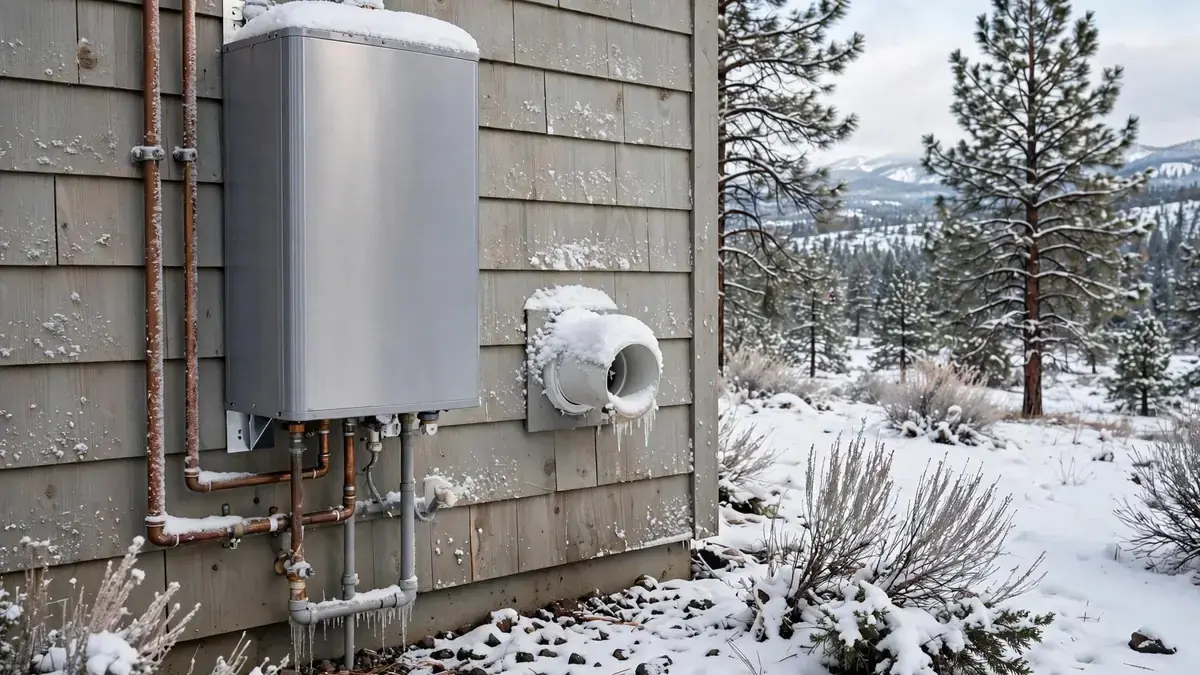
An outdoor tankless water heater cover is a shield, hood or cabinet placed around a wall-mounted heater to keep rain, debris and wind off it. The catch is that a tankless gas unit needs open air to burn fuel and vent exhaust. A cover that blocks either one is worse than no cover at all.
Most outdoor tankless models are built to sit outside without a cover. The better question is what your specific unit needs, what threats your house actually faces and which protections are safe.
Never wrap, box in or tape over a gas tankless heater. Blocked intake or exhaust can cause poor combustion, carbon monoxide and shutdowns. Follow the manufacturer's clearance rules, and ask a licensed plumber before adding any enclosure.
What outdoor models already have built in
Outdoor-rated tankless units have weatherproof casings, a sealed electrical section and a vent terminal designed for open air. Many also include freeze protection that runs a heating element or circulates water when temperatures fall, as long as the unit has power.
That last part is the catch. Freeze protection depends on electricity, and storms cause outages. A unit with no power and standing water in its heat exchanger can freeze and crack during a long outage.
Threats, and what actually helps
| Threat | Does a cover help? | Better protection |
|---|---|---|
| Driving rain and splash | Sometimes, if it is manufacturer-approved | Proper wall mount, sealed vent, drip loop on lines |
| Falling branches or debris | A rigid hood can help | Keep trees trimmed and clear above the unit |
| Freezing during an outage | No, a cover can trap cold | Insulated lines, power backup, drain-down plan |
| Snow or ice buildup | Only if clearances are kept | Keep snow and ice away from the vent |
| Flooding at ground level | No | Mount above expected water, shut off supply early |
| Sun and weathering | Minor benefit | Periodic inspection of paint and seals |
Storm history near Voorhees, NJ
Voorhees was part of the disaster declaration for Hurricane Irene in August 2011. A draft Camden County hazard plan also records one storm on August 4, 2020, when the township received 32 calls for downed trees and flooding.
For a wall-mounted heater, the lesson is practical. Branch strikes, wind-driven rain and ground-level water are the realistic hazards here, so mount height, tree clearance and a plan for outages matter more than a decorative cover.
Source type: Camden County hazard mitigation plan (draft)Cover options compared
Pick the least restrictive option that actually addresses your threat.
No cover
The factory casing is the protection.
- Matches the manufacturer's design
- No airflow risk
- Needs good location and maintenance
Manufacturer cover or hood
A part approved for your model, installed as directed.
- Clearances already tested
- Often covers vent or wind exposure
- May be unavailable for older models
DIY or third-party box
A homemade or generic enclosure around the unit.
- May block air and exhaust
- Can trap heat or moisture
- Can create code and warranty problems
If you are weighing a new unit, a tankless water heater installation plan should settle location, clearance and venting before anything is mounted.
A better plan than a box: protect before a storm or freeze
- 01
Read your manual
Find the clearance dimensions, freeze protection limits and what the maker says about covers. Keep a copy somewhere safe.
- 02
Insulate exposed lines
Wrap the hot and cold lines that leave the unit with foam sleeves rated for outdoor use. Leave the unit and its vents uncovered.
- 03
Keep power on
Freeze protection needs electricity. If outages are common, ask about a backup power option that is safe for your unit.
- 04
Know the drain-down procedure
If a long freeze and outage is coming, your manual may describe how to shut off supply and drain the unit. Follow it exactly, or ask a plumber.
- 05
Check after storms
Look for debris near the vent, loose brackets and signs of water at connections. Do not use the heater if you see damage and smell gas.
Before you buy or build a cover
- ✓Does the manufacturer list an approved cover for this exact model?
- ✓Will it leave the full clearance around the vent terminal and air intake?
- ✓Does it still allow service access and a view of the display?
- ✓Does the installer, not just the seller, say it fits the code and warranty?
- ✓Have you considered moving the unit to a more sheltered wall instead?
Permit rules vary by project, so ask the Voorhees Construction Department if moving or replacing the unit.
Hard water also needs a plan
Weather is not the only thing that shortens the life of an outdoor tankless unit. Scale builds up in the heat exchanger, and an unserviced unit runs hotter and less efficiently. A flush and descale is part of keeping it healthy.
If you ever feel that your heater is unprotected, a service visit costs less than an emergency. Our water heater installation team can review location and clearances, and homeowners in West Berlin and Somerdale can book the same review.
Trade-offs worth weighing honestly
A cover can look tidy, and a manufacturer-approved hood can reduce wind-driven rain on the vent. It also hides the unit, which can delay noticing a leak or error code. And a poor cover can void a warranty.
If the unit is exposed to repeated damage, relocating it or building a proper shelter with open airflow is a better answer than a tight cover. That is a job for a licensed plumber who can check gas, venting and clearances together.
Sources and references
The points above draw on these public standards, codes and guidelines. Rules change, so confirm current requirements with the agency or utility named before you rely on them.
- New Jersey American Water: published water quality report (Delaware system) and Camden County service territory information
- Camden County Hazard Mitigation Plan: municipal annexes (2021 public-review drafts)