
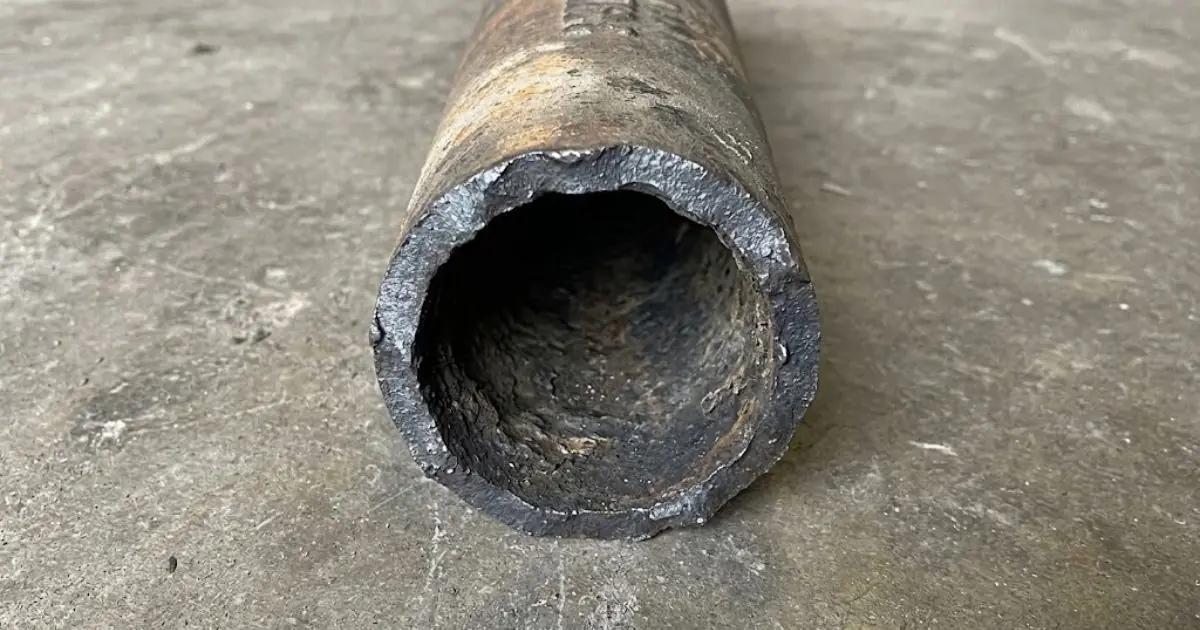
Cast iron plumbing is the heavy, gray, bell-and-spigot or hubless pipe that carries waste out of older houses. It is used for the main stack, the horizontal drain lines under the floor and sometimes the sewer lateral in the yard. It lasts a long time, but the inside surface rusts, scales over and eventually cracks or flakes through.
Repair is rarely all or nothing. A single failed joint can be fixed in a morning, while a pipe that is rusting from end to end usually needs a bigger answer. This guide walks through how to tell which situation you have, what each fix involves and where the honest trade-offs sit.
Why old cast iron fails from the inside out
Waste water is slightly acidic, and it sits in the bottom of a horizontal pipe. Over decades the bottom of the pipe corrodes first, forming rough rust nodules called tuberculation. Those nodules narrow the opening and snag paper, grease and hair.
That is why many cast iron homes have drains that clog every few months even though nothing unusual goes down them. Snaking only clears the soft debris. The rough wall stays, and the clog returns.
The outside can look fine while the inside is nearly gone. A pipe wall that rang solid when it was installed can end up thin enough to crumble when a plumber taps it with a hammer.
Signs and what they usually mean
Use this table to sort what you are seeing. One sign alone is not a verdict, but two or three together point toward a failing line.
| What you notice | Likely cause | Next step |
|---|---|---|
| Repeated slow drains in several fixtures | Scale and rust nodules narrowing the main line | Camera inspection before more snaking |
| Sewer gas smell near a stack or in a wall | Cracked pipe or failed joint leaking vapor | Call a plumber and ventilate the area |
| Gurgling toilets after the washer drains | Partial blockage or a sagging, broken section | Camera inspection of the main drain |
| Brown, flaky debris on a drain snake | Pipe wall flaking away from the inside | Ask for a camera view of the wall condition |
| Sunken or soft spot in the yard above the sewer line | Collapsed or broken lateral | Stop using water heavily and call |
Flaky rust on a snake is one of the strongest hints that a repair, not another cleaning, is the next step.
Cast iron and Voorhees, NJ housing age
Census data for Voorhees shows more than 1,100 housing units built before 1960, with 378 from 1939 or earlier and 639 from the 1950s. Houses from that era are the most likely to still have original cast iron waste pipe in the walls and under the slab.
Most Voorhees housing is newer, with a median build year of 1983, so plenty of homes have plastic drain lines instead. One related point to keep straight: New Jersey American Water has been replacing 1950s cast iron water mains in the street. That is a different pipe in a different place, and it does not tell you anything about the drain inside your house.
Source type: Census ACS housing estimates and New Jersey American Water press releaseFour repair routes and where each one fits
The right fix depends on how much of the pipe is bad, where it runs and what is built on top of it.
Spot repair
A failed joint or short cracked section is cut out and replaced with plastic using a no-hub coupling.
- Fast, with the least disruption
- Leaves the rest of the old pipe in place
- Good when a camera shows the remainder is sound
Section replacement
A longer stretch is cut out and replaced, often where it is reachable in a basement or crawlspace.
- Fixes the worst run for good
- Needs access to the pipe
- Can open walls or break a slab
Lining or full replacement
The whole line is either lined from inside or pulled out and replaced with new pipe.
- Best when corrosion runs the full length
- Larger project and larger cost drivers
- Lining only suits pipe that is still round and connected
For a line that has collapsed, lining is off the table and the pipe must be dug or cut out. A camera run through the line is the only reliable way to know which route you are in, and our sewer inspection service exists for that reason.
A repair is only worth doing if the rest of the pipe can carry it. Patching one joint on a line that is flaking everywhere buys a few months, then the next joint fails. Ask for the camera footage before you approve any spot repair.
What a cast iron repair visit looks like
- 01
Confirm and protect
Water use in the house is limited, the work area is covered, and the section to be cut is supported so the rest of the pipe does not shift.
- 02
Cut out the bad pipe
A snap cutter or reciprocating saw removes the damaged section. Cast iron is heavy and brittle, so supports matter.
- 03
Install the new section
New pipe is joined with shielded no-hub couplings or compatible fittings, and the slope is checked so waste actually flows.
- 04
Test and clean up
Water is run through the line, joints are watched for weeping, and the camera confirms the repair before anything is closed up.
If the damaged pipe runs out into the yard, the project becomes a sewer line repair, with different tools and different questions about who owns which stretch.
What not to try yourself
Do not cut into a cast iron stack. Each stack is a vertical load that supports weight, and a poorly supported cut can drop a heavy section onto you or crack the pipe below. Sewer gas also escapes the moment the line opens.
Do not pour caustic drain cleaner into a line you suspect is failing. It will not remove rust scale, and it can sit in a low spot and attack the pipe wall or injure the next person who opens the trap.
Questions to ask before you approve a quote
Cost depends on length, depth, access, the number of fittings and whether floors or walls need to be opened. Ask these so quotes can be compared fairly.
- ✓Will you show me the camera footage and mark where the damage is?
- ✓How much of the pipe is being replaced, and how much stays?
- ✓What material and fittings are you using, and where do you tie into existing pipe?
- ✓Does the price include opening and closing walls or breaking and patching concrete?
- ✓Does the work need notice to or a permit from the Voorhees Construction Department?
- ✓What happens if you find more damage once the pipe is open?
Permit rules vary with the job, so ask the Voorhees Construction Department. Repairing a leak with like piping is ordinary maintenance under state rules, but a bigger replacement may be treated differently.
When replacing the whole line makes more sense
If the camera shows rough scale along the whole run, repeated clogs at different points and more than one cracked section, stacking spot repairs gets expensive and disruptive. At that point a full run of new pipe is often the cleaner decision, especially if walls are already open for a remodel.
In a house with galvanized supply pipe as well, it can make sense to coordinate the work with repiping so floors are only opened once. The trade-off is a bigger single project, and not every house needs it.
The same decision comes up for older houses in Lindenwold and Gibbsboro, so the camera-first approach applies there too.
Sources and references
The points above draw on these public standards, codes and guidelines. Rules change, so confirm current requirements with the agency or utility named before you rely on them.
- New Jersey American Water: published water quality report (Delaware system) and Camden County service territory information
- U.S. Census Bureau: QuickFacts and American Community Survey 2020 to 2024 estimates