
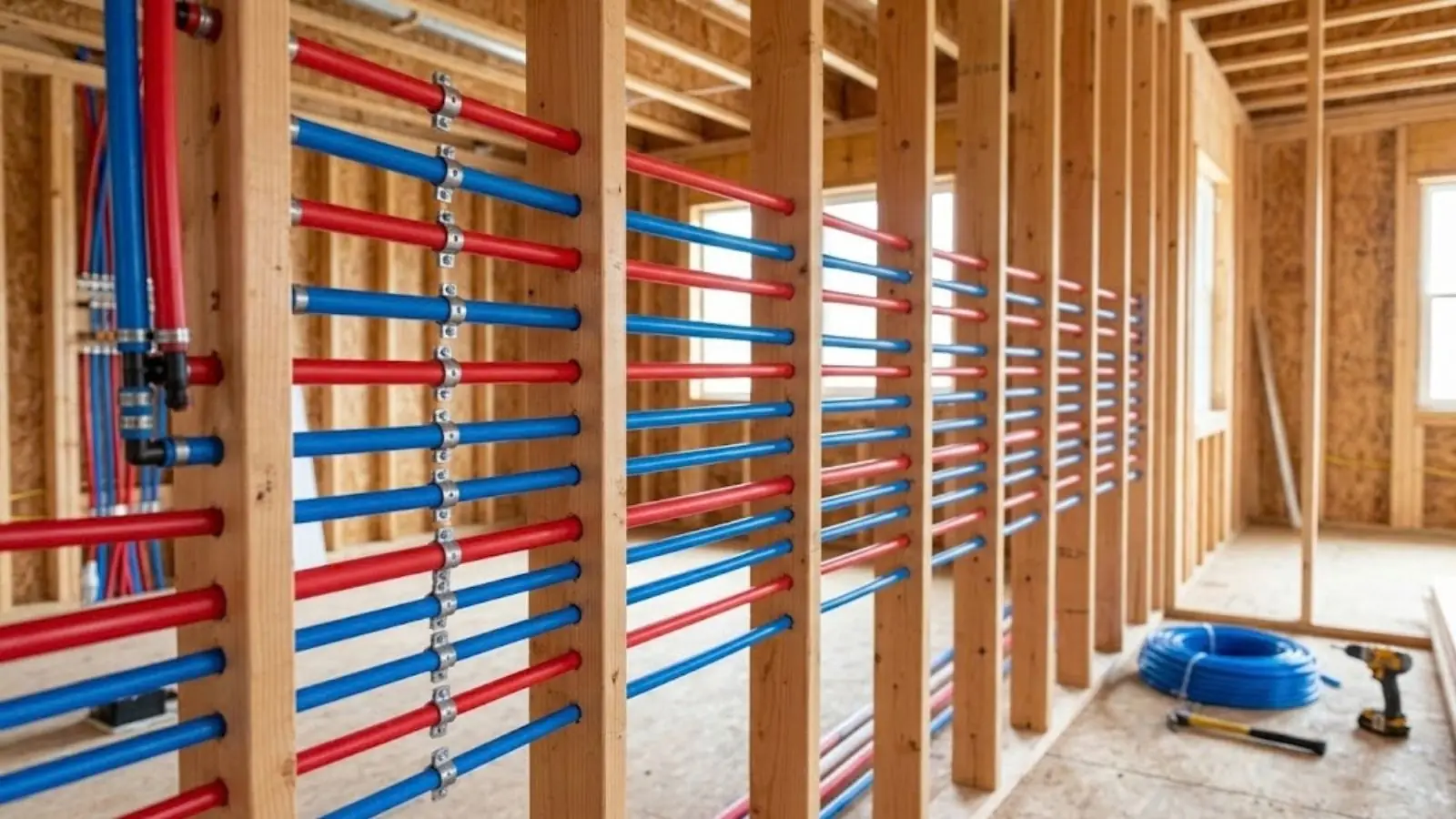
Matching the symptom to the pipe problem
| What you notice | What it points to | Typical answer |
|---|---|---|
| Weak flow at every tap, strong at the meter | Galvanized pipe narrowed by rust | Replace the run, whole-house if widespread |
| Brown or orange water on first use | Rusting steel or iron deposits | Test, flush, then repipe if it returns |
| Tiny sprays or green stains on copper | Pinhole corrosion | Repair if isolated, repipe if multiple |
| Hot water pipes failing first | Heat accelerates wear | Replace hot lines, evaluate cold |
| Wet spot on the slab floor | Leak under the concrete | Reroute overhead or through walls |
| Rising water bills with nothing visible | Hidden leak | Leak detection before deciding |
What to do before we arrive
- ✓Find your main shutoff. Know where the main water valve is and that it turns, because a failing old line can let go without warning.
- ✓Photograph stains and low-pressure spots. Note which fixtures run weak and where ceiling or wall stains show.
- ✓Do not use chemical cleaners on corroded lines. They add stress to thin pipe walls and can splash during a repair.
- ✓Clear access. Empty the cabinet under the kitchen sink and clear the path to the water heater and meter.
Why pipes wear out before the house does
Supply pipes carry pressure all day and fight mineral deposits, soil chemistry and temperature swings. Galvanized steel rusts from the inside until the opening narrows. Older copper can develop pinholes where water chemistry and flow wear the wall thin.
The sign is rarely one big failure. It is a second pinhole six months after the first, or hot water that runs brown for a minute each morning.
How far along is your plumbing
Use this scale to decide how soon to act.
One leak, rest of the pipe looks fine
A spot repair is reasonable. Ask for a look at the nearby pipe while it is open.
Repeat leaks, low pressure, discolored water
The pipe has a pattern of failure. Get quotes and pick a time before the next leak picks it for you.
Leak in a slab, wall or ceiling that keeps coming back
Each repair opens more finished surface. A reroute can cost less than another round of drywall.
Copper or PEX for the new lines
Copper
Rigid, time-tested, soldered joints.
- Handles heat and sunlight well
- Needs more cutting and openings in walls
- Water chemistry can wear it over decades
PEX
Flexible plastic tubing with crimped fittings.
- Snakes through walls with fewer holes
- Resists scale and freezing splits better
- Keep it out of direct sunlight and use proper fittings near the water heater
Neither is right for every house. The choice depends on access, the existing pipe, your plans for the walls, and what the inspector expects.
How a repipe is planned
A repipe is a scheduled project, and the order matters.
- 01
Survey
We trace the existing lines, check shutoffs, pressure and every fixture.
- 02
Choose the route
Through crawlspace, basement or attic first, and walls only where needed.
- 03
Price and permit
You get the scope and price in writing, and permit questions are answered before the work starts.
- 04
Replace and test
New lines go in, are pressure tested, and fixtures are reconnected.
- 05
Patch access
Openings are closed up. Drywall finish and paint can be handled by your contractor.
Pipe age and rules in Voorhees, NJ
Census ACS figures put about 1,100 of Voorhees' housing units in buildings put up before 1960, and the 1970s account for over 2,400 more. Pipe materials varied across those eras, so a house built in 1955 may still have galvanized steel inside, while a 1975 home is likelier to have copper.
On the utility side, a 2021 New Jersey law requires water utilities to replace lead and galvanized service lines by 2031, and New Jersey American Water says it will replace customer-owned lines found to be lead or galvanized. That covers the pipe from the street to the meter and house. See water line repair for that portion, while inside piping is the homeowner's side.
Source type: U.S. Census ACS and New Jersey law on lead service linesPermits and licensed work
New Jersey DCA guidance treats replacing existing piping with approved material of like capacity as minor work, which may begin once the enforcing agency is notified. Piping replaced to repair a leak is ordinary maintenance. Neighbors in Lindenwold and Gibbsboro follow their own boroughs' offices, so check locally. Anything that changes the layout, adds fixtures or alters capacity may be different.
Permit rules vary, so ask the Voorhees Construction Department. Plumbing must be done by licensed persons, and the permit steps should be planned alongside the pipe.
What makes one repipe cost more than another
We give a clear price before work starts. These drivers explain why two houses differ.
Size and fixture count
More bathrooms and outlets mean more pipe and connections.
Access
Open basement ceilings are faster than finished plaster or slab.
Material
Copper and PEX differ in material and labor.
Number of stops
Replacing shutoffs, pressure regulators and hose bibs adds items.
Finish repair
Wall and ceiling patching may be included or left to another trade.
Insurance note. Homeowner insurance may cover sudden water damage from a burst pipe but often does not pay for the pipe replacement itself, so check your policy. When you compare repipe quotes, compare scope: what is replaced, what is reconnected, and what is left for you.
When not to repipe
If the leak is in one fitting and the pipe on either side is clean and thick, repair is the better value. If water pressure is low only on one floor, the cause may be a partly closed valve or an aerator, not the piping.
We will say so if a smaller repair does the job, and a leak locator can confirm before anything is opened.
Getting the house ready
Clear access
Move boxes from basements, closets and under sinks where pipes run.
Plan for water-off hours
Fill pots and bottles and stagger laundry and showers.
Protect finishes
Cover floors in work areas and lift valuables from shelves near walls.
Note your problem spots
Point out where leaks, stains or low pressure show up so we start there.
Sources and references
The points above draw on these public standards, codes and guidelines. Rules change, so confirm current requirements with the agency or utility named before you rely on them.
- New Jersey American Water: published water quality report (Delaware system) and Camden County service territory information
- New Jersey Department of Community Affairs: Construction Code Communicator, Winter 2018
- NJ Division of Consumer Affairs: State Board of Examiners of Master Plumbers FAQ (N.J.S.A. 45:14C-1)
- U.S. Census Bureau: QuickFacts and American Community Survey 2020 to 2024 estimates
- New Jersey American Water: lead service line replacement information
Common questions
Galvanized pipe is dull gray, threaded at the joints, and a magnet sticks to it. Copper is brown or green and a magnet does not stick. Look near the water heater or meter.
No. Partial repiping covers one floor, the hot lines or a single run that keeps failing. We recommend what the pipe condition shows, not the biggest job.
It is usually off in intervals while sections are tied in, and we plan the schedule so you can still use the house. Ask about the timeline in your quote.
Often, yes. Rerouting the line through walls or attic avoids breaking the slab again, though a single clean break may be fixed in place.
If narrowed galvanized or corroded pipe is the cause, yes. If the cause is the street supply or a regulator, it will not, so we test pressure first.
Like-for-like replacement is minor work under NJ DCA, which needs notice to the enforcing agency. Other changes may differ, so ask the Voorhees Construction Department.