
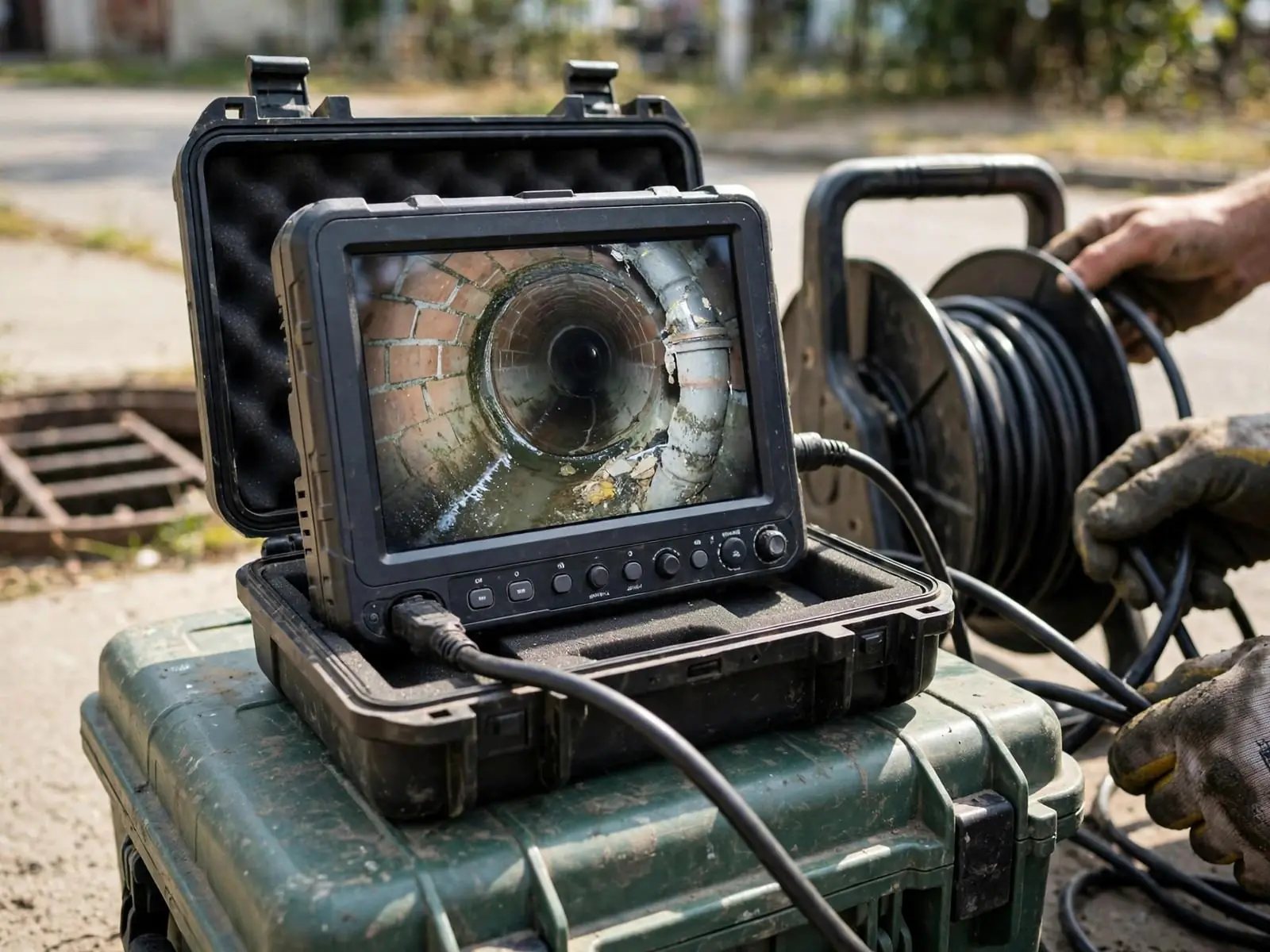
How the camera run works
The visit is short and does not dig up anything.
- 01
Open the cleanout
We find the access point, often outside near the foundation or in the basement, and remove the cap.
- 02
Feed the camera
A flexible rod carries a waterproof camera with lights into the pipe, pushed gently to the connection.
- 03
Watch in real time
We stop at each defect, note its distance from the cleanout and check which way the pipe slopes.
- 04
Locate on the surface
A transmitter on the camera head lets us mark the position above ground when a repair may follow.
- 05
Hand over the footage
You get the recording and a plain summary of what each finding means.
What the camera can show
| Finding on screen | What it means | Typical response |
|---|---|---|
| Roots entering at a joint | A gap in the pipe lets in moisture | Cut roots, then repair the joint |
| Standing water in a low spot | A belly, where the pipe has settled | Monitor or repair, depending on depth |
| Flaking or scaled walls | Cast iron aging | Descale by jetting if sound |
| Offset or separated joint | Soil movement or poor installation | Spot repair |
| Collapsed or oval pipe | Material failure | Replacement |
| Clean, flowing pipe | The line is healthy | Keep the recording for reference |
What the camera cannot do
A camera sees the inside of the pipe only up to where it can travel. A full blockage, a sharp turn or a collapse may stop it short. It does not test whether a line leaks under pressure, and it cannot judge the city main beyond the connection. We will say so in the summary instead of implying more.
Buying or selling a home in Voorhees
Voorhees has 12,772 housing units, many of them resale homes. A buyer who orders a recorded inspection before closing learns about roots, bellies or a failing lateral while there is still room to negotiate.
The township's median home was built in 1983, but the Census survey also counts older housing from the 1950s and earlier. An older house is more likely to have clay or cast iron under the lawn, which makes the inspection worth more.
Source type: U.S. Census Bureau American Community SurveyBook an inspection if any of these apply
- ✓You are buying a house built before 1980 and the seller has no pipe records
- ✓The same drain has clogged twice in a season
- ✓A tree has grown near the line since it was installed
- ✓You smell sewer gas near a floor drain or in the yard
- ✓A previous owner reports a repair but you have no paperwork
- ✓You are planning a basement bathroom or an addition that will add load
Camera inspection versus other checks
Camera inspection
Direct view of the pipe interior.
- Shows cracks, roots and slope
- Produces a recording you keep
- Needs a cleanout or a pulled toilet
Cable clearing alone
Opens the line without looking at it.
- Fixes a simple blockage
- Tells you nothing about the cause
- Fine for a one-off clog only
If your line has not been checked and you have had more than one backup, cabling again without a look is the weaker choice.
What affects the price of an inspection
Line length
A short lateral takes less time than a long run to a far connection.
Access point
A clear exterior cleanout is quick. Entry through a toilet adds setup.
Cleaning first
A heavily blocked pipe may need clearing before the camera passes.
Locating
Marking a defect on the surface adds a step.
Report format
A recording plus a written summary takes more preparation than a verbal check.
Insurance note. Homeowner insurance may not pay for an inspection that is routine, though some policies cover the investigation after a covered loss, so check your policy. If you collect several quotes, confirm that each includes the recording and not only a verbal opinion.
After the footage, what next
A clean result means you can stop worrying and keep the video. A scaled but sound pipe may only need hydro jetting, and a damaged one moves to sewer line repair with the camera findings as the basis for the estimate.
If the report names a repeat clog in the main, sewer line cleaning can restore flow while you plan the next step. Homeowners in Somerdale book inspections for the same reasons.
Sources and references
The points above draw on these public standards, codes and guidelines. Rules change, so confirm current requirements with the agency or utility named before you rely on them.
- NJ One Call: call-before-you-dig safety guidance
- U.S. Census Bureau: QuickFacts and American Community Survey 2020 to 2024 estimates
Common questions
Most runs take a short visit, depending on line length and access. A blocked pipe may need clearing first. We tell you what to expect when you book.
No. The camera enters through a cleanout or an opening such as a pulled toilet. Digging only comes up later, if the footage shows a defect that needs repair.
It is a good idea, especially for homes built before 1980. A recording of the line gives you facts to bring to the negotiation.
Yes. A transmitter on the camera head lets us locate the pipe above ground and note its depth, which helps before any excavation. Call 811 before you dig.
Yes. You receive the recording with notes on the distance of each finding from the cleanout, so you can share it with a contractor or your attorney.
Stop using water and call the 24/7 line. We can clear the blockage first so the camera can pass, then review the footage with you.