
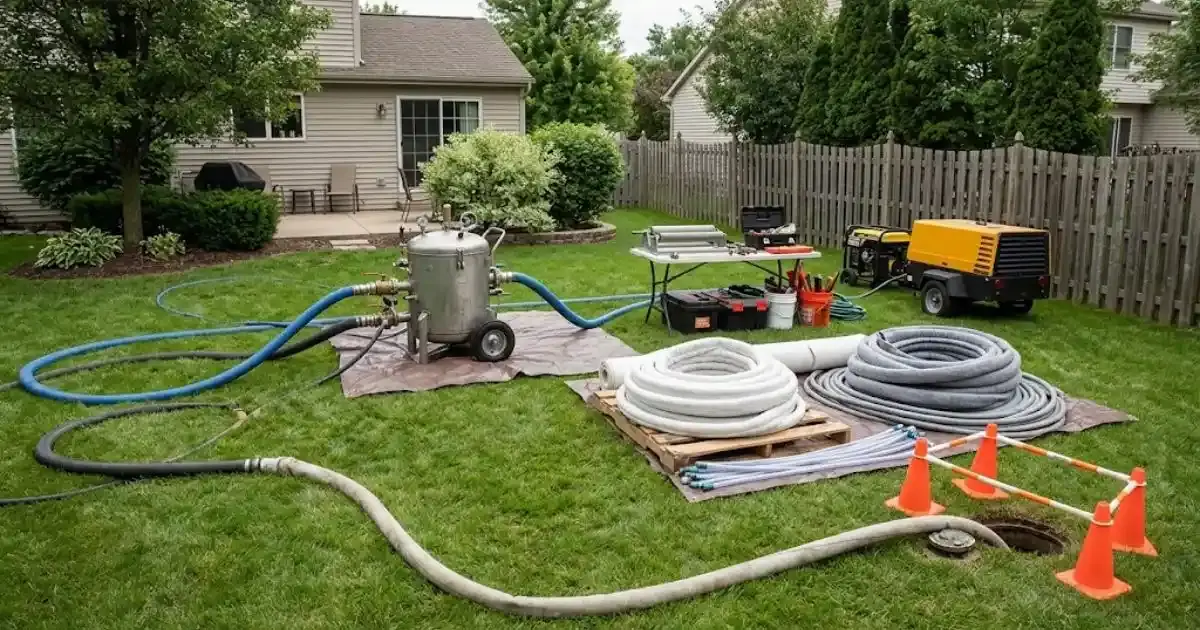
Trenchless sewer pipe lining is a repair method where a resin-soaked liner is pulled or inverted into the old pipe and cured in place, forming a new pipe inside the old one. It avoids digging a long trench through the yard, the driveway or the landscaping. The price depends on the condition of the line, the access points and the length being lined.
Instead of quoting a number that will not match your house, this page explains what moves the price and how to compare offers fairly.
Lining, pipe bursting or open trench
These three methods solve different problems. The right one depends on what the camera shows.
Cured-in-place lining
A resin liner is cured inside the existing pipe.
- Little digging, usually at two access points
- Works on cracks, joint gaps and root entry
- Pipe must be open and mostly round
Pipe bursting
A tool breaks the old pipe while pulling in a new one.
- Replaces the pipe, not just lines it
- Works on collapsed or badly offset pipe
- Needs pits at both ends
Open trench replacement
The yard is dug and the pipe replaced.
- Straightforward and visible
- Most disruptive to landscaping
- Sometimes the only choice
What shapes the price
Two homes on the same street can get very different quotes. These are the usual reasons.
Length of the run
Longer pipe needs more liner and more curing time, and reaching a distant cleanout may need extra access.
Pipe diameter and material
Different sizes use different liners. Cast iron, clay and plastic pipe each require different prep.
Condition before lining
Heavy root growth, scale or offset joints must be cleared first, often by cabling or hydro jetting.
Access and excavation
Lining still needs an entry point. A cleanout is cheap to use, while a missing one may require a small excavation.
Number of bends and tie-ins
Bends, lateral connections and changes in diameter increase the work and the risk.
Restoration
Patching a small excavation in a lawn costs less than repairing concrete, pavers or a deck.
Insurance note. Homeowner policies often exclude wear and tear on sewer pipe, though some offer a line endorsement, so check your policy. A fair quote spells out each of these items instead of folding them into a single total.
Ask the township before choosing a method
In Voorhees, new dwellings need a sewer connection permit from the Camden County Municipal Utilities Authority. The township code also has a section on sewer maintenance and replacement responsibility, which may affect who is responsible for which part of the line.
Before you approve a method, ask the township which part of the lateral is yours. That answer, along with any permit rules, can change the scope and who pays for what.
Source type: Voorhees construction checklist and township code on sewersWhen lining fits and when it does not
| Camera finding | Lining suitable? | Why |
|---|---|---|
| Hairline cracks and joint leaks | Usually yes | A liner seals the interior surface |
| Root intrusion at joints | Yes, after cutting roots | Liner closes the gaps roots used |
| Pipe is round but heavily scaled | Often yes, after cleaning | Surface prep restores flow |
| Collapsed or crushed section | No | Liner cannot form in a blocked pipe |
| Large bellies holding water | Rarely | Lining follows the sag |
| Pipe offset at a joint | Depends on the size of the gap | A big step can snag the liner |
How the lining process works
- 01
Camera inspection
A drain camera records the full run so the plumber can measure length, find defects and check for collapse.
- 02
Cleaning the pipe
Roots and scale are removed with a cable, cutter or hydro jetting so the liner can bond to clean pipe.
- 03
Liner installation
A resin-soaked liner is pulled or inverted into the pipe and pressed against the wall.
- 04
Curing
The resin hardens using hot water, steam or light. This forms the new inner pipe.
- 05
Reinstate and verify
Side connections are reopened, the line is camera-checked, and the cleanout is restored.
If your line has not been scoped yet, start with a sewer inspection so any quote is based on what the camera sees.
Questions to ask every contractor
- ✓Can I see the pre-lining camera footage and the post-lining footage?
- ✓What cleaning is included before the liner goes in?
- ✓How will you reinstate the side connections?
- ✓Does the work include excavation and restoration, or only the lining?
- ✓What material is the liner, and is there a written warranty from the maker?
- ✓Does the township require a permit or inspection?
Do not accept a quote that cannot say whether lining fits until after it has been scoped.
Trade-offs to weigh before you commit
Lining reduces the inside diameter slightly, but usually not enough to affect flow in a household lateral. It does not fix a sagging or collapsed pipe, and if the old pipe is moving, the liner can crack at the weak point.
It also does not replace repairs elsewhere in the system. A cracked cast iron stack inside the house, for instance, is a separate job. A plumber who offers only one method for every house deserves a second question.
Where to go next
If the camera shows damage, discuss lining with a plumber who also does traditional sewer line repair, so the recommendation is not tied to one method.
We work with homeowners in Voorhees and nearby Gibbsboro and West Berlin. If sewage is backing into the house right now, treat it as an emergency and call the 24/7 line.
Sources and references
The points above draw on these public standards, codes and guidelines. Rules change, so confirm current requirements with the agency or utility named before you rely on them.
- Camden County Municipal Utilities Authority: connecting to the sewer