
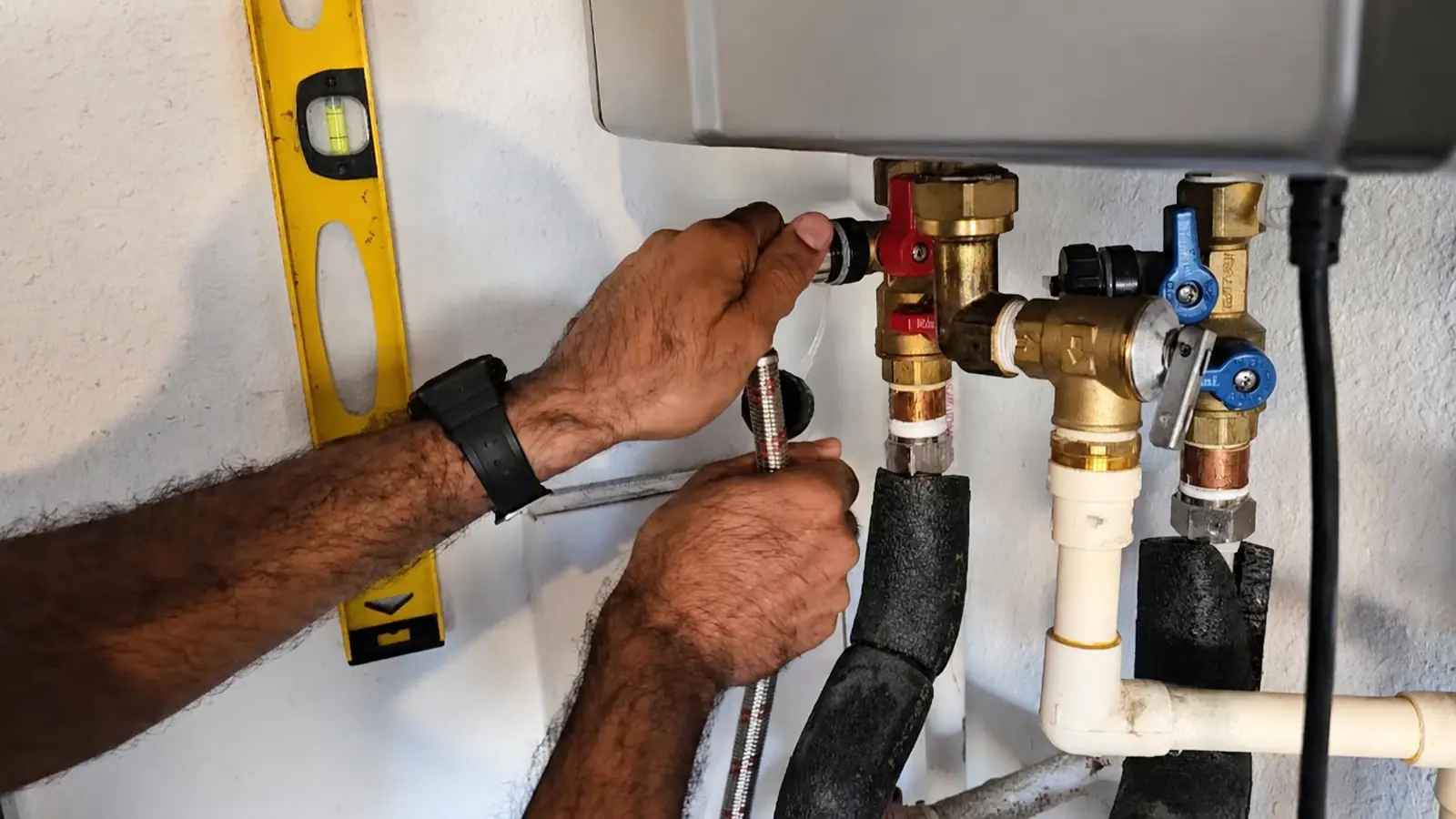
A tankless water heater heats water on demand as it flows through a heat exchanger, so there is no stored tank of hot water. When you open a tap, a flow sensor fires the burner or element and the unit raises the temperature in a single pass.
The savings and the endless hot water are real, but the installation is bigger than a tank swap. Gas lines, venting and hard water all change the job, and this guide explains what each one means for a Voorhees home.
The installation in six facts
These are the points that decide whether a tankless unit fits your house.
Gas units need a larger gas line than most tanks. Electric units need a heavy dedicated circuit.
Gas units use sealed stainless or plastic vent pipes, run to an exterior wall or roof.
Rated by gallons per minute at a temperature rise. Size to how many fixtures run together.
Hard water scales the heat exchanger and needs periodic descaling.
Mounts on the wall and frees the floor area a tank used.
Notice or permit is required, and licensed persons must do the work.
Gas supply and venting come first
Most tankless gas heaters burn more fuel at peak than a tank heater does, because they must heat the water instantly. The existing gas pipe may be too small, and a plumber measures the run length and the total load of other appliances before choosing a size.
Venting is the other big variable. A tank heater often uses a draft hood and a metal flue. A tankless unit usually needs a sealed vent through a wall, and the termination point has to clear windows, meters and corners. Poor venting is a safety issue, not a cosmetic one.
If you smell gas near any water heater
Do not flip switches, light anything or try to find the leak. Gas smells are never a DIY job.
- 1Leave the building right away with everyone inside.
- 2Call your gas utility or 911 from outside.
- 3Do not return until the utility says it is safe.
- 4Call a licensed plumber only after the gas has been cleared.
Hard water and tankless heaters in Voorhees
According to New Jersey American Water's water quality report, Voorhees water carries a hardness of 88 mg/L, or about 5.1 grains per gallon. Water in that range leaves scale on heat exchangers, and tankless units run hot enough to speed it up.
That is why we recommend planning for isolation valves at installation, so the unit can be flushed with a mild descaling solution each year. A whole-house softener or scale inhibitor is another option, and it is worth discussing during the quote.
Source type: New Jersey American Water water quality reportTankless or another tank: which suits your house?
Neither choice is wrong. The right pick depends on your demand and your piping.
Tankless makes sense when
Hot water use is steady and space is limited.
- You can upgrade the gas line or circuit
- The vent path to the outside is short and clean
- You are willing to descale each year
- A long-term stay in the house is likely
A new tank is the better call when
The home would need major gas or venting changes.
- The gas meter and piping are undersized
- No clean exterior wall is available for the vent
- Your hot water use is light and occasional
- You want the simplest like-for-like swap
Our team covers both options under tankless water heater service and water heater replacement, and we will tell you plainly if a tank suits your home better.
How the installation day unfolds
- 01
Survey and sizing
The plumber checks incoming water temperature, fixture count, gas line size and the vent route.
- 02
Removal of the old tank
The old heater is drained, disconnected and carried out. Gas and water are capped safely.
- 03
Mounting and connections
The unit is mounted to the wall, and the isolation valves, gas line and condensate drain (for condensing models) are connected.
- 04
Venting and combustion test
Vent pipes are run and sealed, and the burner is tested for proper combustion and gas pressure.
- 05
Start-up and walkthrough
The unit is programmed, the temperature set, and the owner is shown the controls and the flush ports.
Permit and licensing rules matter here. Under the NJ Department of Community Affairs, plumbing work must be done by licensed persons, and Voorhees permit details are best confirmed with the Construction Department.
Questions to ask before you sign a quote
- ✓Is the gas line sized for the new unit and my other appliances?
- ✓Where will the vent terminate, and is it clear of windows?
- ✓Are isolation valves and a flush kit included?
- ✓What happens to the old tank and the old flue?
- ✓Is a condensate drain needed, and where does it go?
- ✓What does the quote exclude, such as drywall or electrical work?
A trade-off most sales pages skip
Tankless heaters can show a brief cold sandwich, a burst of cold water between two hot draws. Recirculation lines and unit tuning help, but it is a real behavior, not a defect. Decide whether you can live with it before you buy.
Before you decide
The same questions come up in Gibbsboro and Somerdale, and the answers depend on the house. Call (855) 575-2890 and we will walk through your setup.
Sources and references
The points above draw on these public standards, codes and guidelines. Rules change, so confirm current requirements with the agency or utility named before you rely on them.
- New Jersey American Water: published water quality report (Delaware system) and Camden County service territory information
- New Jersey Department of Community Affairs: Construction Code Communicator, Winter 2018
- NJ Division of Consumer Affairs: State Board of Examiners of Master Plumbers FAQ (N.J.S.A. 45:14C-1)