
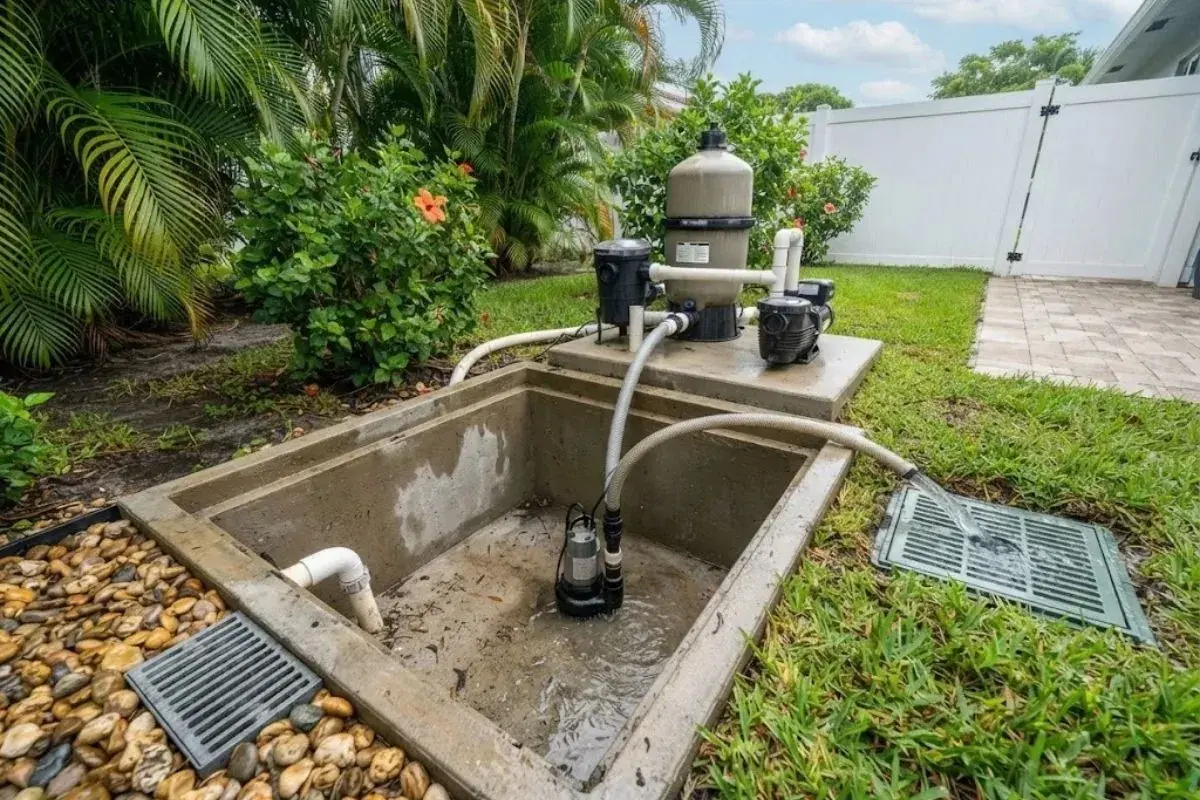
A sump pump is a submersible pump that sits in a pit in the lowest part of the basement or crawlspace and pushes groundwater out of the house before it can flood the floor. The outside part of the system is the discharge line that carries that water through the wall and away from the foundation. Both halves have to be right or the pump just recycles water back toward the house.
This guide covers the layout, the digging safety step that people skip, the discharge rules of thumb and a clear list of what is reasonable to do yourself and what is not.
The system at a glance
A lined basin set below the slab so water collects in it
A submersible pump with a float switch or a vertical float
Stops water in the line from falling back into the pit
Solid pipe through the rim joist or wall to the outside
A spot that carries water well away from the foundation
A GFCI-protected outlet, ideally on its own circuit
Call 811 before any digging in Voorhees, NJ
Running a discharge line to a drain, a dry well or a lower part of the yard usually means digging a trench. In New Jersey, you must contact NJ One Call by dialing 811 at least three business days before you dig. Utilities will mark buried lines.
Within two feet of a marked line, dig by hand. This applies to homeowners too, and it matters because gas, water and electric lines can be shallower than people expect.
Source type: NJ One CallThe installation sequence
These steps describe a typical install in a basement with a slab. Each house is different.
- 01
Pick the low spot
Find the lowest corner or where water enters first. Check for buried pipes before you cut concrete.
- 02
Break the slab and dig the pit
Cut a clean opening with a concrete saw, dig a hole sized to the basin, and set it level on a bed of gravel.
- 03
Set the pump and check valve
Place the pump on a firm base so the float moves freely, thread the discharge pipe, and install the check valve above the pump.
- 04
Run the discharge through the wall
Drill through the rim joist or foundation wall at a height that leaves a clean exit, then seal the opening around the pipe.
- 05
Extend the line outdoors
Connect solid pipe to a route that slopes away from the house. Mark the line, call 811 first, and keep any trench clear of utilities.
Test the system by filling the pit with a hose, confirming the float turns the pump on and off and watching the outside outlet for steady flow.
Where the discharge water should and should not go
| Option | Good for | Watch out for |
|---|---|---|
| Lawn or yard, well away from the house | Simple installs on sloped lots | Water that runs back to the foundation or onto a neighbor |
| Splash block or extension at the outlet | Spreading flow gently | Ice buildup in cold weather |
| Dry well or buried drainage | Properties with soil that drains | Needs digging and correct sizing |
| Storm drain or street | Some municipal setups | Ask the township first, rules vary |
| Sanitary sewer | Not a safe assumption | Do not connect without written approval |
Do not assume a sump can connect to the sanitary sewer. Ask the township and the Voorhees Construction Department before choosing a discharge point.
Do it yourself or hire a plumber
Reasonable DIY
Replacing a pump in an existing pit or extending a discharge hose to a safer spot.
- Pump swap with the power off
- Adding a splash block
- Cleaning the pit and checking the float
Better with a plumber
New pit, new discharge route or any change that touches the foundation.
- Breaking concrete safely
- Sizing the pump and line
- Placing the discharge correctly
A basic sump pump swap is often manageable. A new pit and discharge route is a bigger job, and permit rules vary, so ask the Voorhees Construction Department before starting.
How urgent is your water problem?
Damp walls or an occasional damp floor
You have time to plan a pit and choose a discharge route.
Water after heavy rain
Get the pump in before the next storm. Move valuables up off the floor.
Standing water, a failed pump or water near the electrical panel
Stay out of the water and call a plumber. Electricity and water together are a shock hazard.
Safety and mistakes to avoid
Never work on a pump while it is plugged in, and never stand in water to do it. Use a GFCI outlet, and do not run extension cords across a wet floor.
Common mistakes include discharging too close to the foundation, forgetting the check valve, and burying a line too shallow for winter. A long discharge hose that freezes will make the pump run and push nothing.
Why flooding history matters in Voorhees
The Camden County hazard plan ranks the township's flood hazard as High and names Burnt Mill Road and Somerdale Road among the places with flooding problems. Hurricane Irene in 2011 was a declared disaster. Dry months do not predict the next heavy storm.
Homeowners in nearby Lindenwold and Gibbsboro should ask the same question: is a basement waterproofing system needed on top of a pump? If water enters through the walls as well as the floor, a pump alone may not be enough.
Before you buy parts
- ✓Do you know where water enters and how often?
- ✓Is there a GFCI outlet within reach of the pit?
- ✓Have you checked a backup option for power loss, such as a battery system?
- ✓Do you have a discharge route that slopes away and does not cross a neighbor's yard?
- ✓Have you called 811 if any digging is planned?
Sources and references
The points above draw on these public standards, codes and guidelines. Rules change, so confirm current requirements with the agency or utility named before you rely on them.
- NJ One Call: call-before-you-dig safety guidance